
Air Duct Cleaning: Repair or Replace? How Kaysville Homeowners Decide
Here’s the short answer: clean your ducts only after you know the ductwork can hold clean air. If the system leaks, sags, or has failed connections, cleaning first wastes money. In our experience across Kaysville, most homes need repair and sealing before cleaning, not replacement. If you’d rather not work through that on your own, call (877) 792-5756 and we’ll help you sort it out.
A leaky duct system is the part most homeowners never see. It sits above a ceiling, under a floor, or in an attic, quietly bleeding conditioned air into spaces that don’t need it. Then a cleaning company arrives, pushes a brush through it, and hands over a receipt. Three months later the dust is back and the power bill hasn’t moved. That’s not a cleaning problem. That’s a duct problem.
Key Takeaways
- Cleaning is worth doing only if the ducts are structurally sound enough to stay clean.
- Leaking ducts usually waste conditioned air before it ever reaches a room.
- Failed flex connections, deteriorated duct board, missing end caps, and unsupported runs are the defects that make cleaning short-lived.
- Sealing with mastic beats tape in almost every case; some ducts need partial replacement instead.
- Cleaning and sealing in one visit is the most cost-effective sequence.
- Our technicians have up to 12 years of experience, and we use Rotobrush and Nikro equipment built for this work.
How do I know if my Kaysville ducts are leaking?
You can spot most duct leaks without a pressure test. Three signals show up again and again in Kaysville homes: a temperature difference between rooms that share a thermostat, utility bills that climb without a matching change in weather, and rooms that never quite reach the set temperature no matter how long the system runs. Any one of them is worth investigating. Two or three together usually mean the duct system is losing air somewhere between the furnace and the register.
Walk through the house on a cold morning and put your hand near each supply vent. If the air from one register feels noticeably weaker or warmer than another on the same zone, the problem likely sits in the run feeding it. In older Kaysville homes, that run is often in an attic or crawlspace where nobody has looked in years.
You can also check the utility bill against the season. A furnace that runs longer than it should while the house stays cool is working against a leak. Before you blame the equipment, look at the ducts carrying the air.
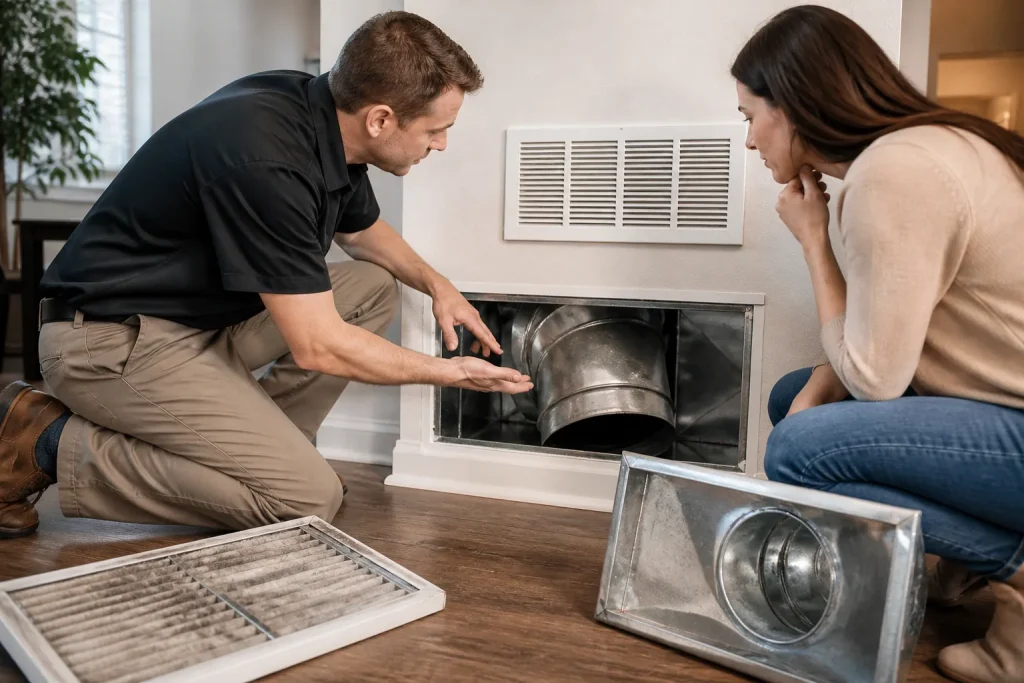
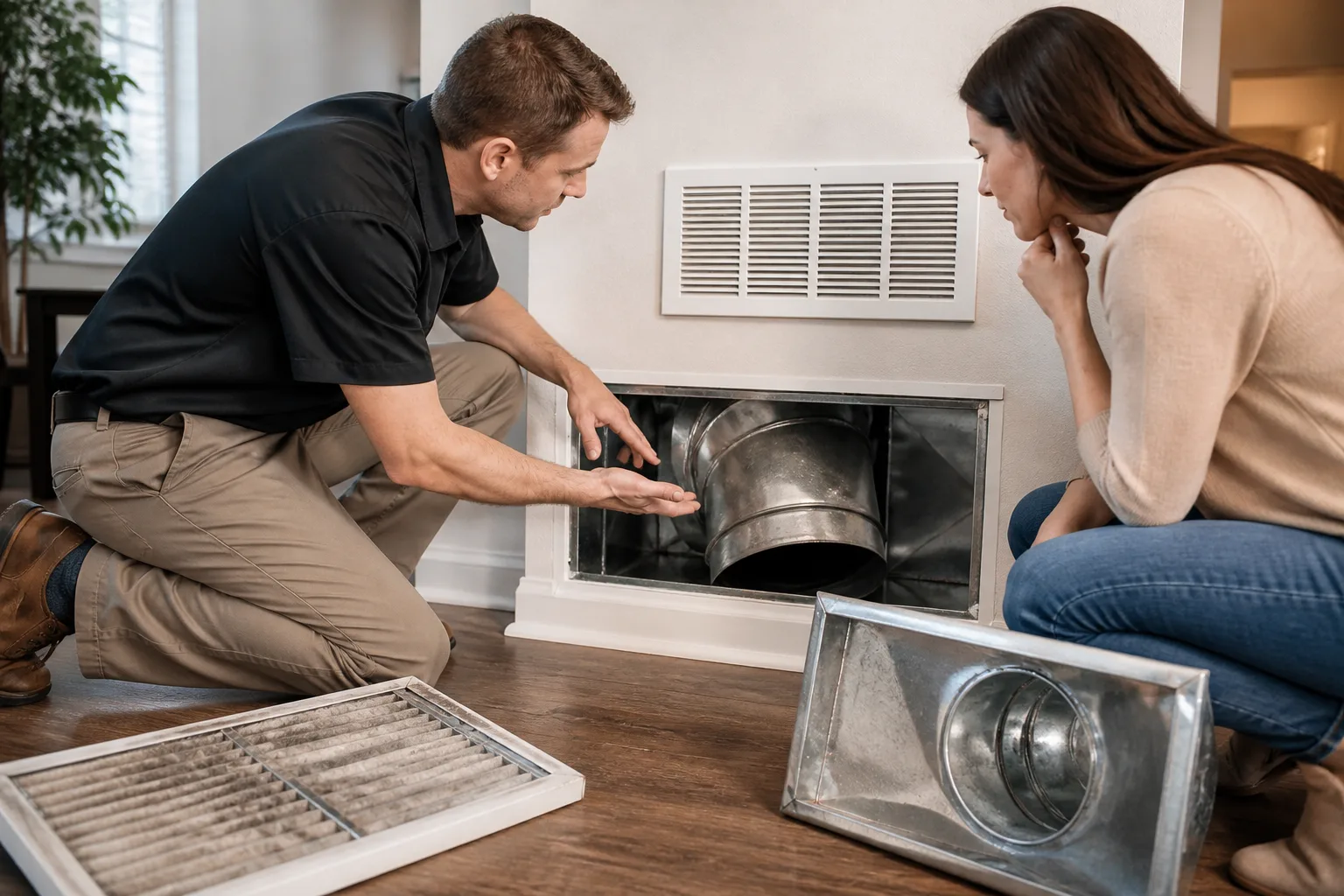
What you can’t check from the hallway is what’s happening inside the duct system itself. That’s where a proper inspection with HEPA-filtered equipment, like the Nikro systems we run, shows the real condition: separated joints, crushed flex, torn insulation, duct board that’s gone soft. Those findings decide whether cleaning makes sense at all.
Which duct defects make cleaning a waste of money?
Certain defects make cleaning pointless until they’re fixed. If a duct system has any of these, a brush and vacuum will remove dust that returns almost immediately:
- Failed flex duct connections. The inner liner separates from the collar, and air escapes at the joint before it reaches the room.
- Deteriorated duct board. Older duct board breaks down over time. Once the surface is compromised, it sheds fibers and can’t hold a seal.
- Missing end caps. An open duct end dumps conditioned air into an attic or crawlspace. The register at the other end runs weak as a result.
- Unsupported horizontal runs. Flex duct that sags between hangers creates low spots where dust collects and airflow drops.
- Crushed or kinked sections. A duct pinched behind a joist or squashed under insulation restricts flow and traps debris.
Each of these is a structural problem, not a cleanliness problem. Cleaning a duct with any of them is like mopping a floor while the sink overflows. The water keeps coming.
In our experience in Kaysville, the flex connections are the most common failure we find, especially in homes where ductwork runs through unconditioned attic space through hot summers and cold winters. The temperature swings work on the joints and the tape over years. Eventually something gives.
When does sealing make more sense than replacement?
Sealing makes sense when the duct material itself is sound. If the metal or flex is intact and the problem is at the joints, seams, and connections, mastic and proper mechanical fastening will fix it and last. Replacement makes sense when the duct material has failed: soft duct board, torn flex liner that can’t be repaired, or runs so badly installed that sealing won’t hold the shape.
Here’s the distinction that matters. A sealable duct has good material with a bad connection. A duct that needs replacement has bad material. Tape alone rarely qualifies as a real seal on either, because standard duct tape dries out, loses adhesion, and peels within a season or two in a hot attic. Mastic, applied over a properly fastened joint, seals and stays sealed. That’s the standard we hold to when we do air duct cleaning and repair together.
Partial replacement is the middle path and the one most Kaysville homes actually need. A single collapsed flex run or a deteriorated section of duct board gets replaced. The rest of the system is cleaned and sealed. You’re not paying to redo ductwork that’s still doing its job.
What does duct repair and sealing cost in Kaysville?
Costs vary by the size and condition of the system, so treat these as typical ranges rather than quotes. A standard Kaysville home usually falls into one of these brackets:
| Work | Typical estimated range |
|---|---|
| Cleaning only (whole system) | $300 – $600 |
| Sealing existing ducts (mastic and fastening at accessible joints) | $400 – $900 |
| Partial replacement (one or two failed runs) | $500 – $1,200 |
| Cleaning plus sealing in one visit | $650 – $1,300 |
These are estimates, not fixed prices. The written estimate sets the final price, and we agree to it before any work begins. That’s the rule: one flat price per system, no per-vent pricing surprises.
Now weigh those numbers against a cleaning-only quote. If the ducts leak, you’ve paid for a clean you’ll need to repeat. The money is better spent on the repair and seal that lets cleaning last. That’s not a pitch for more work. It’s the sequence that saves money.
Why does cleaning and sealing together save money?
Cleaning and sealing belong in one visit because each makes the other work. Seal first and you’ve locked dust into the leaks. Clean first and you’ve sealed nothing. Doing both together means the ducts come out clean and stay that way, because there’s nowhere for new dust to enter and no conditioned air escaping before it reaches a room.
The sequence we follow is simple. We inspect and identify the defects. We repair and seal what needs fixing. Then we clean the whole system with the rotary-brush and HEPA equipment to remove what’s there and leave the interior ready. When the ducts are structurally sound, that clean holds. Rooms get the airflow the system was designed to deliver, and the furnace or air conditioner stops working against leaks.
This is also where whole-home upgrades fit. We install Aprilaire and Honeywell products that handle filtration and humidity control at the system level, and Abatement Technologies filtration for higher-containment situations like post-renovation work. Those installs make sense on a sealed system. On a leaky one, they don’t.
The same logic applies to dryer vent cleaning, which some homeowners use as a proxy for a duct inspection. It’s worth doing on its own merits, but it doesn’t tell you anything about the supply and return ducts feeding your living space. Also worth considering is HVAC cleaning, since the air handler and coil share the same pathway. A dirty coil plus leaky ducts is a double hit to efficiency.
When should you call a pro instead of checking yourself?
If you’ve spotted weak airflow, uneven temperatures, or a utility bill that doesn’t match the season, that’s the point to call. You can check vents and registers yourself, but you can’t open an attic run or inspect duct board without the right equipment. A proper diagnosis with professional-grade tools, not a shop vac and a flashlight, tells you what you’re actually dealing with before you spend on the wrong service.
Call (877) 792-5756 to book an inspection. We answer 24/7, and fast dispatch runs from 7am to 7pm, Sunday through Friday.
Worth knowing: some duct work is genuinely not a do-it-yourself job. If a duct runs near electrical wiring or gas lines, or if it sits in a tight attic space, leave it to a trained professional. We find the problem, then fix it, and that includes knowing when to step away from a task that carries real risk.
Related services in Kaysville
Whether you need cleaning, sealing, or both, the full scope covers the air pathway from intake to output. Start with Kaysville Air Duct Cleaning to see how the services fit together, and we’ll help you decide what your system actually needs.
The Bottom Line
Before you pay for cleaning, find out whether your ducts can hold clean air. If they’re leaking through failed connections, deteriorated duct board, or unsupported runs, repair and sealing come first. Seal, then clean in the same visit. That’s the order that makes your money count and gives you a system that stays clean instead of one that needs cleaning again next season.
If you’re in Kaysville and need help deciding, Kaysville Air Duct Cleaning offers free estimates. We use Rotobrush and Nikro equipment built for professional duct work, and we handle repair and sealing alongside cleaning so the fix lasts. Call (877) 792-5756 to get started. We answer 24/7, with fast dispatch from 7am to 7pm, Sunday through Friday.
Frequently Asked Questions
Repair and seal first, then clean. Cleaning a leaky system wastes money because dust and debris return through the same leaks, and conditioned air escapes before it reaches your rooms. Seal the system, then clean it in the same visit so the ducts start clean and stay that way. Call (877) 792-5756 for an exact quote – estimates are free.
Whole-system cleaning in Kaysville typically runs $300 to $600 as an estimate, and cleaning plus sealing runs $650 to $1,300. The written estimate sets the final price, and there’s no per-vent pricing. Call (877) 792-5756 for an exact quote – estimates are free.
Low quotes usually come from companies that clean a leaky system, skip the repair side, and charge per vent. The cheap number covers a surface clean that doesn’t address the leaks destroying your air quality and energy bills. One flat price per system, agreed before work starts, is the honest structure. Call (877) 792-5756 for an exact quote – estimates are free.
Ask for before-and-after photos of your own ducts. A company that does the work and stands behind it will show you what was there and what changed. We photograph the system before and after so you can judge the result yourself. Call (877) 792-5756 for an exact quote – estimates are free.
Written by the team at Kaysville Air Duct Cleaning.
Need Air Duct Cleaning Help?
Call Kaysville Air Duct Cleaning - the local pro we connect you with is licensed and insured, with free written estimates in Kaysville.
(877) 792-5756